The Adult in the Room · Part 2 of 8
Nothing Happened
The most damaging workplace mistreatment is built so that describing it out loud makes you sound unwell.
· 7 min read
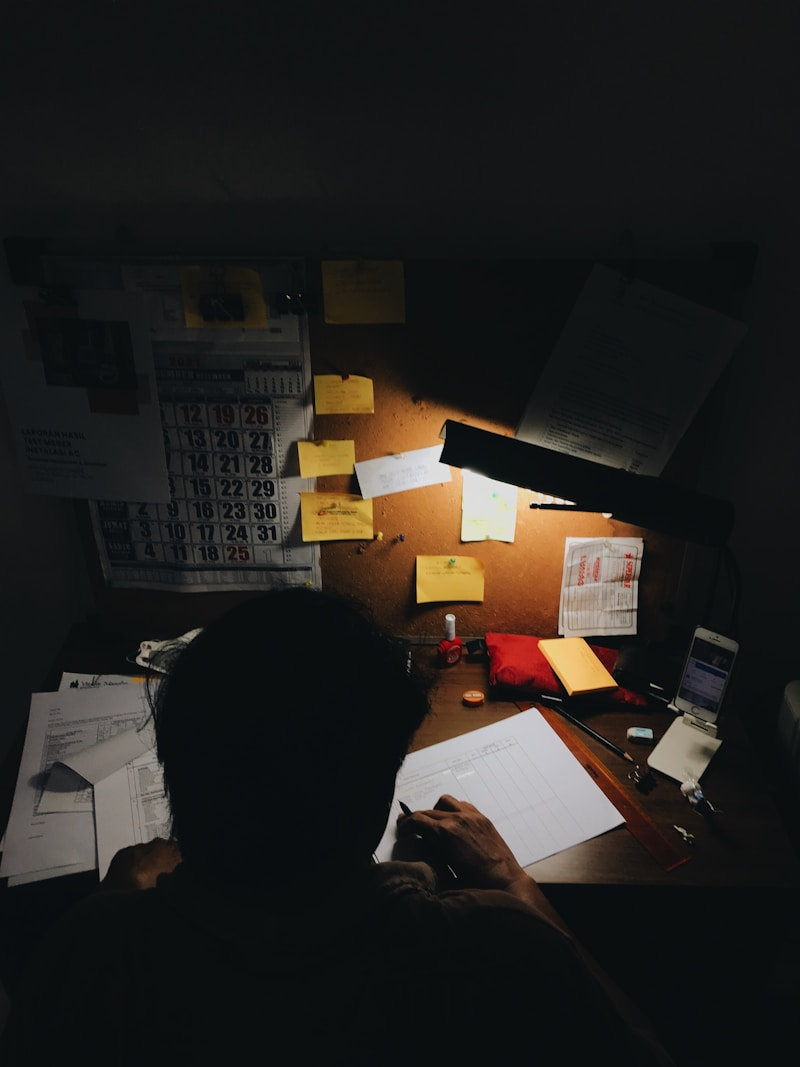
He sat down to write the list because he had finally decided to go to HR, and he understood, in some vague way he'd absorbed from television, that you were supposed to bring documentation.
So he opened a document and started at the beginning.
February. Not told about the schedule change. Found out secondhand.
He looked at it. It was true and it was nothing. Schedules change. People forget to forward things. He left it and kept going.
March. Asked a question in the morning meeting. Nobody answered. Someone answered the next person.
Also true. Also nothing. Maybe they hadn't heard him.
April. The thing at the desk.
He stopped there, because "the thing at the desk" had taken about four seconds and could not be written down at all. A look, held a half-second too long, passed between two people while he was talking, and then dropped. He had felt it in his stomach for the rest of the day. On the page it did not exist.
He read the list back. Three entries. Any one of them, read aloud to a reasonable person, would produce a patient silence and then a gentle question about whether he'd been under a lot of stress lately.
He closed the document.
This is the part nobody warns you about. Not that people will be cruel to you, but that the cruelty will be structured in such a way that describing it makes you sound unwell.
Every mechanism we have for handling this assumes an incident.
A discrete event, with a time, a place, and a person who did it. Something one party can report and another can verify. That assumption runs through the whole apparatus: intake forms, policies that prohibit specific acts, investigations that go looking for what happened on a particular Tuesday afternoon. It is, from end to end, a machine for processing events.
And the cruelty adapted, the way anything adapts to a predator, by becoming the thing the predator cannot see.
Here is a detail that ought to be better known, because it means the researchers figured this out a long time ago.
The standard scientific instrument for measuring workplace bullying is the Negative Acts Questionnaire, a 22-item scale that asks how often you've experienced specific behaviors, never using the word "bullying" until the very end. It is the most widely validated measure in the field, and it sorts its items into three dimensions.
One of those three dimensions is social exclusion.
Look at that with an administrator's eyes. A third of the recognized structure of workplace bullying, according to the instrument researchers actually use, consists of things that do not happen. Not being told. Not being invited. Not being answered. There is no act to prohibit and no event to investigate, because the entire category is defined by absence.
The science has known this for thirty years. The complaint form has not caught up, and it isn't going to, because you cannot write a policy that forbids someone from failing to include you.
Now the finding that should be on a poster in every HR department in the country, and is on none of them.
A team led by Jane O'Reilly, publishing in Organization Science, ran the comparison directly. They asked American workers to rate how socially appropriate and how harmful various workplace behaviors were. They surveyed 1,300 full-time employees about what they'd actually experienced and how much they felt they belonged. And then, in the part that gives the study its teeth, they took a Canadian university employment survey and linked it to who had actually quit three years later.
Two results came out of it.
The first: people consistently rated exclusion as less serious than overt mistreatment. Belittling a coworker, threatening one, insulting one, all of that registered as clearly worse than leaving someone out. That's not surprising. It matches how every policy in the country is written.
The second: the ratings were wrong. Ostracism did more damage than harassment. It was more corrosive to people's sense of belonging, to their commitment, to their engagement. The people who'd been excluded reported more health problems. And three years on, they were the ones who had left.
Exclusion was also far more common. More than 70% had experienced it within six months, against 48% reporting harassment or bullying.
So the most frequent form is the one we consider least serious, the one no policy prohibits, and the one that actually drives people out of the building.
At this point the reasonable objection arrives: surely being left off an email is not comparable to being screamed at. Surely some of this is a matter of resilience.
The ostracism research answers that more brutally than I would have.
Kipling Williams and colleagues have spent decades on this using a paradigm called Cyberball, a stripped-down online ball-tossing game in which a participant is quietly stopped from being thrown to. More than five thousand people have gone through versions of it, and the findings replicate with unusual reliability.
A few minutes of it, in a game the participant knows is trivial, produces measurable distress. It threatens four distinct things at once: belonging, self-esteem, sense of control, and the feeling that one's existence is meaningful.
And it does all of that when participants are told the other players are computers. It does it when they're excluded by a group they actively despise. Knowing it shouldn't matter provides no protection whatsoever.
An earlier line of neuroimaging work suggested that exclusion activates some of the same brain regions as physical pain, and that finding gets quoted constantly. It has also been seriously contested since, on the grounds that the patterns involved are more distinct than the original interpretation allowed. I mention it because you will encounter it, and because the behavioral results above do not depend on it at all.
Which means the man staring at his three-line list, feeling sick over a look that lasted four seconds, was not being fragile. He was having the response the human nervous system produces on contact with exclusion, on schedule, at the correct intensity. The only unusual thing about him was that he'd been trained to treat that response as evidence of a defect in himself.
The perfected version of the fingerprint-free weapon is the rumor, and it deserves its own accounting.
A rumor has no author by the time it reaches you. Whoever started it has long since been laundered out of the chain, and every person who repeated it did so in a voice that made repeating it sound like concern. There is no incident. There is no date. There is no document. Deny it and you have confirmed that there is something to deny. Ignore it and you have declined to defend yourself, which the room will also interpret.
And a rumor, uniquely among weapons, survives its own retraction. The person who started it can stand up and take it back, and it will keep moving, because by then it no longer belongs to her. It belongs to the building.
There is no HR process anywhere that can touch this, and it is not because HR is lazy. It is because a rumor is not an event. It is a weather condition.
Remote work did not fix any of this. It handed the same weapon a better delivery system.
Almost every tool we now work through is exclusion-native. A thread you were left off. A channel you were never added to. A meeting that happened and was never mentioned. A message marked read and left there. None of it requires anyone to say anything, all of it is instantly deniable as an oversight, and each instance now leaves a timestamp that proves only that a person is counting.
The office at least required your tormentor to be in the room. Distributed work removed even that inconvenience.
Which returns us to the man with the three-line list.
He was not failing to build his case. He was discovering that no case could be built, because the weapon had been selected, consciously or not, for precisely that property. Everything true about what had happened to him lived in the space between those lines, and the space between lines is not admissible anywhere.
He closed the document and concluded he had nothing. What he actually had in front of him was the complete and characteristic evidence of the most common form of workplace mistreatment there is.
So here is the question, and I'd ask you to answer it honestly rather than generously.
When someone has tried to describe this to you, and it came out sounding small, and thin, and a little paranoid, and you found yourself wondering whether they were making more of it than it was:
Were they? Or had you just been handed the only evidence that this particular weapon ever leaves behind?
Sources
- O'Reilly, J., et al., "Is Negative Attention Better Than No Attention? The Comparative Effects of Ostracism and Harassment at Work," Organization Science. Multiple samples including 1,300 full-time U.S. workers and a Canadian university employment survey linked to turnover three years later. Summary via Association for Psychological Science.
- Williams, K. D., & Nida, S. A., Ostracism: Consequences and Coping, Current Directions in Psychological Science. Cyberball paradigm, over 5,000 participants across studies.
- Negative Acts Questionnaire-Revised, Einarsen, Hoel & Notelaers, Work & Stress. 22-item instrument, three dimensions: person-related, work-related, and physically intimidating or socially excluding acts.
Identifying details in the opening account have been removed or changed.